
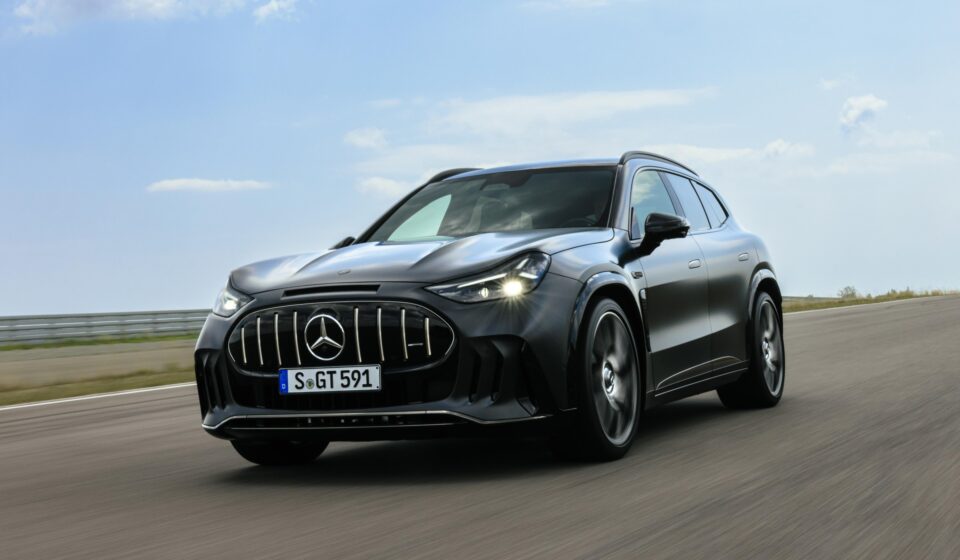

Mercedes-AMG has taken the wraps off the 2028 Mercedes-AMG GT SUV, the first full-size SUV the performance division has developed entirely in-house. The reveal marks a significant expansion for a brand that has spent 59 years building its reputation on modified Mercedes-Benz models and, more recently, on standalone performance cars. This time, AMG has engineered a complete full-size electric SUV from the ground up, using its dedicated AMG.EA high-performance architecture and a powertrain built around three axial flux motors.
The GT SUV will arrive in US showrooms in summer 2027 as a 2028 model year vehicle. Three trims are planned: GT 53, GT 55, and GT 63. Mercedes-AMG has not announced pricing, and several key specifications—including power output for the lower two trims, torque figures, acceleration times, top speed, dimensions, towing capacity, and warranty details—remain undisclosed. EPA range estimates are also pending, though the company has provided WLTP-based figures for the larger battery pack.
Three trims, one very powerful flagship

The headline number belongs to the GT 63, which produces 1,153 horsepower from its three axial flux motors. That is the same motor configuration found in the AMG GT four-door coupe, which was revealed earlier in 2026 with over 1,150 hp. In the SUV, the GT 63’s output exceeds that of the Porsche Cayenne Turbo Electric with Launch Control, according to the brief. Power for the GT 53 and GT 55 has not been released.
All three trims come standard with the AMGFORCE Sport+ drive program, a setting that presumably sharpens throttle response and chassis behavior. The GT 63’s power advantage over the Cayenne Turbo Electric gives AMG a strong talking point in the high-performance electric SUV segment, where Porsche has already established a presence.
Battery, charging, and range

The GT 63 and GT 55 use a 128 kWh battery pack, while the GT 53 makes do with a 106 kWh unit. Both packs operate on an 800-volt electrical architecture. Peak charging power is 710 kW for the 128 kWh models and 600 kW for the GT 53. Mercedes-AMG claims a 10-to-80 percent charge can be completed in 12 minutes, and that the larger battery can add up to 450 km (about 280 miles) of WLTP range in 10 minutes.
Estimated maximum range for the 128 kWh models is 435 miles on the WLTP cycle. The brief does not provide a range estimate for the 106 kWh GT 53. The charging figures are notably high: the 710 kW peak for the 128 kWh models compares with 320 kW for the Porsche Cayenne Turbo Electric, a difference that could give Mercedes an edge in long-distance usability if real-world charging delivers on the claim.
The battery itself uses NCMA cathodes, silicon-containing anodes, and cylindrical cells. Mercedes describes the chemistry as F1-inspired. Thermal management is handled by nonconductive oil that flows around each individual cell, a design intended to enable continuous high power output without overheating. The company has been developing this battery technology quietly, and the GT SUV represents its most visible application yet.
Suspension and weight

AMG has equipped the GT SUV with active hydraulic suspension elements in place of mechanical roll bars. The system is designed to eliminate pitch and roll, keeping the body flat during cornering and braking. Three-stage air springs are standard, as is six-degree active rear-axle steering, which should help the big SUV maneuver at low speeds and remain stable at highway pace.
The GT 63 SUV weighs 5,941 lbs. That is lighter than the Lotus Eletre R at 6,007 lbs and the Lucid Gravity at 6,100 lbs, and nearly matches the Porsche Cayenne Turbo Electric at 5,960 lbs. For a full-size electric SUV with more than 1,100 hp, the weight figure is competitive within its class, though it remains substantial in absolute terms.
Sound and driving experience

Rather than relying on synthetic tones, AMG has recorded real engine sounds from its V8 and six-cylinder engines and pipes them through the cabin. The system includes simulated gear shifts via paddle controls, adjustable sound profiles, and seat vibrations. Mercedes-AMG states that real engine sounds preserve the emotional identity of the AMG brand, a rationale that acknowledges the challenge of making an electric performance vehicle feel as dramatic as its combustion-powered predecessors.
The driving experience is further shaped by the Predictive Performance Manager, or PPM. This system uses track-mapping data to adjust motor output based on topography, conserving battery energy on downhill and winding sections. Mercedes-AMG claims the PPM improves lap consistency by managing battery temperature. For track-focused drivers, the combination of PPM, active suspension, and rear-axle steering suggests the GT SUV is intended to handle more than straight-line acceleration.
Interior technology and AI

Inside, a 14-inch display runs the MB.OS platform. The infotainment system integrates AI agents from ChatGPT, Microsoft, and Google. An onboard AI assistant handles HVAC, drive modes, and lighting via voice commands, and the system can also perform navigation, web searches, and even tell jokes, according to the brief. A 78-liter front trunk, or frunk, provides additional storage space.
The AI integration reflects a broader industry push toward voice-controlled vehicle functions, but AMG’s implementation appears focused on consolidating multiple assistants into a single interface. Whether the system delivers on its promise in everyday use will have to wait until production models reach customers.
Launch timing and market position

The 2028 Mercedes-AMG GT SUV will launch in the US in summer 2027. Pricing has not been announced, nor has an exact on-sale date within that window. The vehicle enters a growing field of high-performance electric SUVs, including the Porsche Cayenne Turbo Electric, the Lucid Gravity, and the Lotus Eletre R. AMG’s first in-house full-size SUV will need to justify its place against those rivals, particularly on price and real-world range.
For now, the GT SUV represents a clear statement of intent: AMG is no longer content to modify existing Mercedes-Benz platforms for its largest vehicles. The GT 63’s 1,153 hp, the 710 kW charging capability, and the F1-inspired battery technology are all evidence that the performance division intends to compete at the front of the electric SUV pack. What remains unknown—price, EPA range, acceleration, and the power output of the GT 53 and GT 55—will shape how the market receives it when it arrives next summer.